Introduction
Living with chronic hip pain can affect every part of your daily routine, from walking and working to sleeping and enjoying simple daily activities. When persistent discomfort lingers, finding the right healthcare team and hospital can feel confusing. Many patients find themselves looking at multiple facilities, reading online reviews, and wondering which center actually has the right expertise for long-term hip care.
Imagine sitting at your kitchen table after months of persistent hip discomfort, trying to research different healthcare providers. You find three different hospitals that mention hip treatment. One offers a quick evaluation package, another has a well-known name, and a third is recommended by a neighbor. None of them appear identical. You start wondering how to look past the marketing descriptions to find out which hospital actually has the right specialist experience for your specific symptoms.
Different hospitals have different clinical strengths, and understanding hip specialist qualifications, diagnostic facilities, treatment options, patient communication, and rehabilitation support helps you make a confident decision. Resources like HipHospitals.com can help patients research hip care options and explore hospital information before making a choice.
Featured Snippet
How Do You Choose the Right Hospital for Chronic Hip Pain?
Patients can choose the right hospital by comparing hip specialist qualifications, hospital experience, diagnostic and treatment facilities, available treatment approaches, quality information, rehabilitation and follow-up care, patient communication, and treatment costs. The appropriate hospital always depends on the patient’s condition and individual healthcare needs.
Understanding Chronic Hip Pain
What Is Chronic Hip Pain?
Chronic hip pain generally refers to discomfort in or around the hip joint that persists for an extended period, often lasting several months or longer, even after initial rest or basic home care.
Why Proper Assessment Matters
Long-lasting hip pain can stem from various sources, including joint wear, cartilage issues, tendon strain, bursitis, or structural hip problems. Because causes vary widely, a proper medical evaluation by a qualified healthcare professional is essential to understand what is causing the discomfort before any treatment plan is considered.
When Should Someone Consider Specialist Hip Care?
Patients often consider consulting a hip specialist when hip pain continues for a long time, keeps returning, or interferes significantly with walking, standing, or normal daily activities. Previous treatments that have not provided sufficient relief or the need for a second opinion are also common reasons to seek specialist guidance.
Note: Severe pain following a major injury, inability to bear weight on the leg, sudden severe symptoms, or hip pain accompanied by fever require prompt medical attention.
Key Factors to Consider When Choosing a Chronic Hip Pain Hospital
Hip Specialist Experience
Check whether the hospital features qualified orthopedic specialists or hip surgeons who regularly treat chronic hip conditions. Reviewing their clinical training and experience with similar conditions provides helpful context.
Hospital Experience
Look for hospitals that handle a steady volume of orthopedic and hip care cases. Facilities with active orthopedic departments often have experienced nursing teams, specialized operating suites, and established care pathways.
Diagnosis and Assessment
Access to comprehensive diagnostic tools, such as advanced imaging services, is crucial for evaluating hip pain accurately. Ensure the hospital offers thorough evaluation processes before any treatment is recommended.
Treatment Options
Chronic hip pain can be managed through various approaches, ranging from physical therapy, medications, and pain management to surgical intervention or hip replacement in selected cases. A good hospital should offer a balanced range of treatment alternatives tailored to individual diagnoses.
Hospital Facilities
Examine whether the facility provides modern diagnostic equipment, dedicated orthopedic treatment units, physical therapy spaces, and comfortable inpatient rooms.
Quality and Credentials
Look for recognized health accreditations and institutional quality standards. If specific quality certifications or rankings are not publicly stated by the hospital, note them as unverified rather than assuming their presence.
Patient Communication
Clear communication between the medical team, patient, and family is vital. Check if the hospital offers appointment coordination, clear guidance, and support services for patients traveling from afar.
Follow-Up and Rehabilitation
Recovery from hip treatments often requires structured rehabilitation and physical therapy. Confirming what post-treatment support and follow-up appointments the hospital provides helps ensure ongoing care is well-managed.
Chronic Hip Pain Hospital Comparison Table
| Factor | What Patients Should Check | Why It Matters |
| Hip specialist | Qualifications and relevant experience | Helps patients research appropriate expertise |
| Hospital experience | Experience with hip and orthopedic care | Provides useful context about the hospital |
| Assessment | Available diagnostic and evaluation services | Supports proper treatment planning |
| Treatment options | Surgical and non-surgical services where appropriate | Helps patients understand available care |
| Facilities | Relevant treatment and rehabilitation facilities | Supports different stages of care |
| Quality information | Available credentials and standards | Helps patients review hospital quality |
| Follow-up care | Rehabilitation and post-treatment support | Helps patients plan ongoing care |
| Cost information | What the estimated cost includes | Supports financial planning |
How to Compare Hip Hospitals
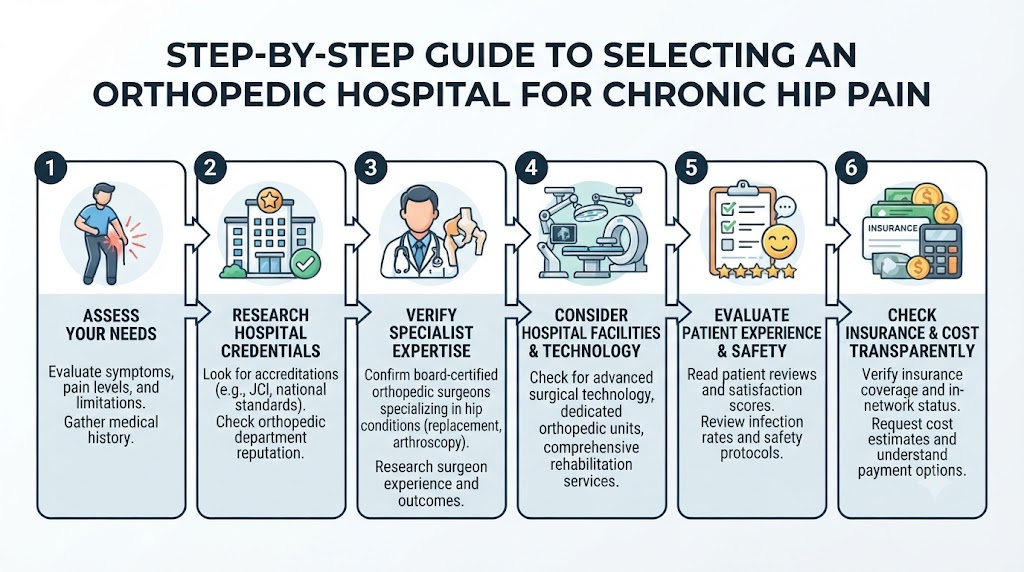
Comparing hip hospitals involves a step-by-step approach. Begin by identifying your specific hip concerns through a local doctor. Research hospitals that feature dedicated orthopedic departments, and cross-reference the credentials of their attending specialists. Compare diagnostic capabilities, available treatment modalities, quality accreditations, and transparent cost estimates. Finally, discuss your findings with a qualified medical professional to determine which option aligns best with your health profile.
How to Evaluate Hip Treatment Costs
Treatment costs vary depending on the patient’s condition, treatment type, hospital, specialist, location, and services included. Avoid choosing a hospital based solely on the lowest price quote. Ensure your cost estimate accounts for specialist consultation fees, diagnostic tests, hospital stay charges, surgical fees or non-surgical therapy sessions, medications, implants where applicable, and follow-up rehabilitation. Requesting an itemized breakdown prevents unexpected financial stress.
Questions to Ask Before Choosing a Hip Hospital
- Does the hospital regularly treat hip conditions?
- Which type of hip or orthopedic specialist should I consult?
- What are the specialist’s qualifications and relevant experience?
- What assessment and diagnostic services are available?
- What treatment options are available?
- Does the hospital provide rehabilitation or follow-up care?
- What quality information can I review?
- What is included in the treatment estimate?
- Are there additional costs?
- Who can I contact if I have questions?
For Patients Considering Treatment Abroad
Patients exploring hip care outside their home country face unique planning requirements. In addition to reviewing hospital reputation and specialist credentials, international patients must securely transfer medical records, arrange remote video consultations, verify language support, and organize travel itineraries. Understanding hospital admission workflows, local accommodation, and structured post-treatment follow-up plans is essential before booking travel.
Common Mistakes When Choosing a Hip Hospital
- Choosing Only by Price: Selecting a facility based purely on low cost while ignoring clinical capabilities.
- Choosing Only by Online Rankings: Relying on unverified online lists instead of objective institutional quality indicators.
- Ignoring Specialist Experience: Failing to check whether the attending physician specializes specifically in orthopedic or hip disorders.
- Assuming Surgery Is Always Needed: Believing that visiting a hip hospital automatically means undergoing surgery.
- Not Checking Treatment Options: Overlooking whether the hospital offers comprehensive non-surgical care alongside surgical services.
- Ignoring Rehabilitation: Neglecting to plan how physical therapy and post-treatment recovery will be handled.
- Not Asking About Follow-Up: Failing to clarify how ongoing care will be managed after leaving the hospital.
- Trusting Every Online Claim: Taking promotional advertising claims at face value without verifying credentials.
How HipHospitals.com Can Help Patients
HipHospitals.com serves as an informational resource designed to help patients navigate hip hospital selection, research healthcare options, and explore specialist details. The platform offers educational guides that assist families in understanding orthopedic care structures.
HipHospitals.com does not provide medical diagnoses, guarantee hospital admissions, secure specific doctor appointments, promise treatment outcomes, or guarantee lowest prices. All healthcare choices should be made in close consultation with qualified medical professionals. Hospital services and availability vary and must be verified independently.
Real-World Patient Scenarios
Patient With Long-Term Hip Pain
- Challenge: Arthur experienced persistent hip stiffness and discomfort for over a year that made walking difficult.
- Research Process: He used online orthopedic care guides to identify hospitals with dedicated joint and hip clinics.
- Decision Factors: He compared specialist qualifications, diagnostic imaging technology, and non-surgical therapy programs across regional centers.
- Planning Considerations: Arthur scheduled an initial evaluation at a hospital offering comprehensive physical therapy and diagnostic reviews.
Patient Comparing Two Hip Hospitals
- Challenge: Brenda faced a recommended hip procedure and needed to compare two different specialty hospitals.
- Research Process: She requested itemized cost sheets and treatment outlines from both facilities.
- Decision Factors: She compared surgeon credentials, hospital case volumes, and rehabilitation packages rather than looking at flat base rates.
- Planning Considerations: Brenda clarified potential extra charges for post-procedure therapy before making her final choice.
Patient Considering Hip Replacement
- Challenge: Charles was advised to consider hip replacement surgery for advanced joint wear related to his hip condition.
- Research Process: He reviewed hospital surgical suite standards, orthopedic care support, and hip surgeon board certifications.
- Decision Factors: He selected a hospital recognized for specialized joint replacement surgery and structured inpatient recovery protocols.
- Planning Considerations: Charles discussed expected recovery timelines and home rehabilitation requirements with his care team.
International Patient
- Challenge: Diana lived in a region with limited orthopedic specialists and decided to travel abroad for specialized evaluation and care.
- Research Process: She reviewed international hip patient support guides and verified foreign hospital accreditation standards.
- Decision Factors: She completed a remote video consultation with an overseas hip specialist and coordinated medical record transfers.
- Planning Considerations: Diana organized her medical travel visas, local recovery accommodation, and a long-term follow-up plan with her home physician.
Chronic Hip Pain Hospital Selection Checklist
- Understand your healthcare concern and general diagnosis
- Speak with a qualified healthcare professional for guidance
- Research relevant hip hospitals and specialized centers
- Review specialist qualifications and board certifications
- Check the hospital’s experience with hip and orthopedic conditions
- Review available non-surgical and surgical treatment options
- Check quality information and safety accreditations
- Request itemized cost estimates and inclusions
- Understand rehabilitation and physical therapy programs
- Confirm follow-up care arrangements before treatment
Hospital Selection Decision Framework
Hip Pain Concern $\rightarrow$ Specialist $\rightarrow$ Hospital Experience $\rightarrow$ Assessment $\rightarrow$ Treatment Options $\rightarrow$ Facilities $\rightarrow$ Quality $\rightarrow$ Cost $\rightarrow$ Rehabilitation $\rightarrow$ Follow-Up Care $\rightarrow$ Final Decision
Evaluating your options through this structured workflow ensures that all clinical, operational, and financial aspects of hip care are accounted for. The “right” hospital is one that aligns with your personal medical requirements and is endorsed by your treating physician.
Future of Hip and Orthopedic Care
The healthcare landscape continues to evolve with digital innovations. Online hospital research platforms, telemedicine, and virtual specialist consultations make it easier for patients to access hip care information globally. Digital medical records enable rapid sharing of diagnostic imaging files across facilities, while AI-supported educational tools help patients formulate better questions. Technology enhances connectivity and transparency, but it always serves to complement—never replace—the expert judgment of qualified medical professionals.
FAQ SECTION
How do I choose the right hospital for chronic hip pain?
You can choose the right hospital by assessing your specific hip concerns, evaluating hip specialist qualifications, reviewing diagnostic and treatment facilities, and discussing options with your doctor.
What should I look for in a hip hospital?
Key factors include experienced orthopedic specialists, comprehensive diagnostic imaging, balanced non-surgical and surgical treatment options, quality accreditations, and rehabilitation support.
How important is a hip specialist’s experience?
A hip specialist’s experience is vital because specialized training and regular handling of hip conditions contribute to accurate evaluation and confident care delivery.
Should I choose a hospital based only on treatment cost?
No. Cost is an important practical factor, but choosing solely based on the cheapest price can overlook vital clinical quality, safety, and rehabilitation standards.
How can I compare two hip hospitals?
You can compare hospitals by reviewing their hip specialist credentials, diagnostic equipment, treatment modalities, safety accreditations, patient support services, and itemized cost estimates.
What facilities should I check before choosing a hip pain hospital?
Patients should check advanced diagnostic imaging capabilities, specialized orthopedic treatment units, physical therapy spaces, and inpatient recovery rooms.
Does chronic hip pain always require surgery?
No. Many chronic hip pain conditions are managed effectively through non-surgical approaches, such as physical therapy, medications, and lifestyle modifications, depending on the diagnosis.
When might hip replacement be considered?
Hip replacement may be considered when joint damage causes severe pain and functional limitations that do not respond sufficiently to non-surgical treatments, as recommended by a specialist.
Why is rehabilitation important for hip treatment?
Rehabilitation and physical therapy help restore strength, improve mobility, support proper walking mechanics, and reduce the likelihood of lingering discomfort after treatment.
How can HipHospitals.com help patients research hip care options?
HipHospitals.com provides informational guides, hospital overviews, and specialist research resources to help patients navigate their hip healthcare planning journey.
Conclusion
Choosing a hospital for chronic hip pain requires careful, structured research rather than rushed decisions based on marketing claims or low prices. Patients should look beyond promotional packages to evaluate true clinical experience, hip specialist expertise, facility standards, and rehabilitation support. Reviewing hospital quality information, understanding cost inclusions, and prioritizing robust follow-up care create a solid foundation for long-term hip health.
International patients require additional coordination, including remote consultations, secure record transfers, and proper travel planning, to ensure safe transitions. Making informed decisions helps reduce anxiety and prepares patients for a smoother healthcare journey. Take time to research your options and discuss your hip pain management thoroughly with a qualified healthcare professional.